

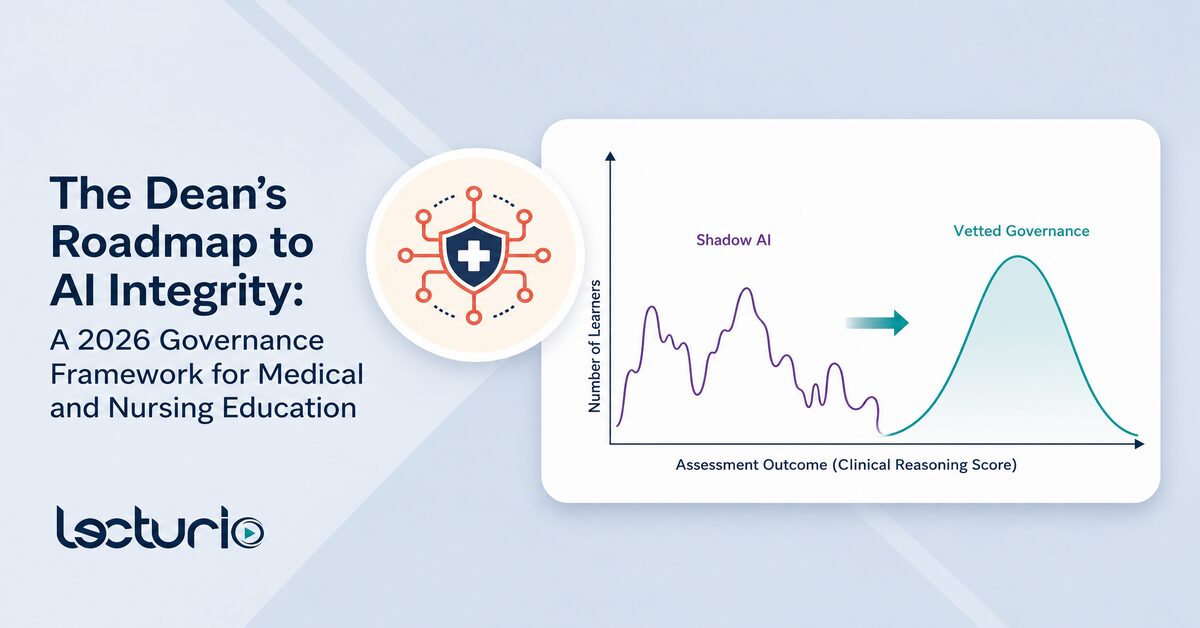
At a glance: Institutional AI governance is the formal system of policies, oversight, and ethical guidelines that health professions schools use to manage the integration of artificial intelligence into academic, clinical, and research settings. By moving from fragmented ‘Shadow AI’ to a centralized, institutional framework, schools protect academic integrity, secure sensitive data, and maintain vital accreditation standards.
The Leadership Pivot: From Reaction to Resilience
In 2026, the “fear phase” of artificial intelligence has been replaced by a strategic focus on governance. For institutional leaders, the challenge is no longer just preventing academic misconduct; it is about ensuring that technology does not erode the requirements for self-directed learning and clinical logic. Leading an AI-resilient institution requires a roadmap that transitions students and faculty from consumer-grade “Shadow AI” to vetted, institutional-grade environments by optimizing the 4 dimensions of an AI-ready health professions institution.
Current research indicates that faculty struggle to verify student-authored content because AI detection tools lack the accuracy to differentiate between human and AI-generated work. Consequently, leaders must pivot toward assessment redesigns, such as oral defenses and authentic artifacts, which better evidence student contribution.
Redefining Academic Integrity in the Generative Era
Effective governance begins with a clear understanding of what constitutes “permissible use.” Following the AAMC AI Policy Development Checklist, many institutions are adopting a three-tier usage framework:
- Prohibited: Generally limited during high-stakes assessments and foundational learning tasks to safeguard the development of primary clinical reasoning. However, because permissible use varies by institution, some schools are transitioning toward heavily supervised or strictly disclosed AI integration rather than an outright ban.
- Permitted with Attribution: Allowing tools for brainstorming, structural organization, or language polishing, provided there is a formal disclosure process.
- Encouraged: Using AI for complex patient simulations, large-scale data analysis, and personalized study paths that convert assistance into durable learning through metacognitive scaffolds.
Rather than relying on unreliable detection software, policies now mandate disclosure plus process evidence, requiring students to submit prompt logs and version histories. This ensures transparency and helps faculty identify AI hallucinations where models generate plausible but factually incorrect clinical information that could adversely influence clinical reasoning or patient care decisions.
Eliminating “Shadow AI”: Security and Data Privacy
One of the most significant risks to institutional security is the use of unvetted, consumer-facing tools. Entering protected health information (PHI) or confidential educational records into non-institutional AI platforms is a high-risk violation of HIPAA and FERPA.
Institutions must provide a single source of truth by listing all AI tools that have been officially vetted for security and privacy. Furthermore, clinical guardrails must prohibit the entry of PHI into non-institutional tools and restrict AI-assisted note-taking to supported, secure electronic health records (EHR). Partnering with a secure, institutional platform allows Deans to provide students with the benefits of AI without the risks associated with data mining or privacy breaches common in consumer platforms.
Table 1: Institutional AI Transformation Matrix
| Transition Domain | Legacy State (2023–2024) | Optimized State (2026) | Institutional Outcome |
| Usage Logic | Unvetted “Shadow AI” | Vetted Institutional Platforms | Robust Risk Mitigation & Enhanced Compliance |
| Integrity Focus | Reactionary Detection | Disclosure + Process Evidence | Increased Student Accountability |
| Faculty Role | Policing and Monitoring | Modeling and Mentored Use | Reduced Faculty Workload |
| Assessment | One-shot Written Outputs | Iterative Drafting & Oral Defense | Verified Clinical Reasoning |
The Interprofessional Governance Roadmap: Step-by-Step
Implementing a school-wide policy is a multidisciplinary effort. Institutions following best practices ensure that AI adoption supports cognitive autonomy—the learner’s capacity to make independent judgments rather than relying on external cues.
- Policy Planning: Assemble a cross-disciplinary committee (Medicine, Nursing, IT, and Compliance). Policies should align with existing research ethics and data governance standards.
- Content & Structure: Ensure the policy applies across academic, research, and clinical settings. Mandate clinical supervisor oversight when learners use AI in patient-care contexts.
- Ownership & Review: Assign clear responsibility to the Office of Medical/Nursing Education. Commit to annual or semiannual reviews to keep pace with rapidly evolving technology.
Leadership Ethics: Equity, Transparency, and the Human Practitioner
Institutional leaders must ensure that AI does not become a tool of exclusion. AI literacy interventions must be culturally responsive and accessible to prevent a digital divide. By utilizing Universal Design for Learning (UDL) principles, AI can increase accessibility for learners with diverse needs rather than stratifying participation.
Ultimately, the goal of governance is to preserve the “human-in-the-loop.” While AI can act as a powerful co-pilot for synthesis and formative feedback, the final clinical judgment and ethical responsibility always remain with the human practitioner. By fostering epistemic hypervigilance—the continuous questioning and verification of AI outputs—Deans ensure their graduates are prepared for the complex, atypical clinical scenarios that no algorithm can fully master.
Just as learners require AI literacy, faculty also need structured development opportunities to understand the strengths, limitations, and appropriate uses of AI in educational and clinical contexts. Without this support, governance frameworks may exist on paper but fail to translate into consistent educational practice.
Effective AI governance is not about restriction—it is about creating a “Safe Harbor” for innovation. Lecturio provides the secure, institutional-grade infrastructure that allows Deans to meet AAMC and AAN standards for 2026 and beyond, ensuring your students remain at the center of the learning experience.
Schedule a Demo with the Lecturio team today.
Frequently Asked Questions
How do AI detection tools affect academic integrity policies in 2026?
AI detection tools are widely recognized as unreliable and are used as secondary evidence rather than primary proof of misconduct. Policies now emphasize “process evidence,” such as prompt logs, to verify that students have engaged deeply with the material rather than simply outsourcing their reasoning.
What are the primary data security risks of using AI in medical education?
The greatest risk is the entry of protected health information (PHI) or student records into consumer AI models that may store or use that data to retrain their algorithms. Schools mitigate this by providing secure, institutional-grade AI platforms that ensure data privacy and strictly comply with HIPAA and FERPA regulations.
How can Deans ensure AI integration improves clinical reasoning?
Deans can ensure improvement by implementing “hallucination-aware pedagogy” and assessments that require students to critique, adapt, or reject AI suggestions. This forces learners to exercise their own clinical judgment and maintain the cognitive autonomy necessary for safe patient care.