
At a glance: A structured disaster medicine curriculum is an educational framework developing essential competencies like leadership under pressure, critical thinking during uncertainty, crisis communication, and interprofessional collaboration. This system prepares healthcare graduates for managing mass casualty events, infectious disease outbreaks, climate-driven crises, and acute humanitarian emergencies within existing institutional constraints.
Introduction: The Crisis Readiness Paradox in Medical Education
The traditional medical education environment faces a severe paradox. Most health professions students graduate without formal, structured disaster medicine training, entering a professional ecosystem where public health emergencies, mass casualty events, and climate disasters are increasingly prevalent. According to global data tracked by the Ecological Threat Register 2020, ecological and systemic disruptions continue to escalate globally. Currently, disaster medicine education remains highly fragmented, relying heavily on optional extracurricular activities rather than formalized institutional curricula.
This programmatic deficit carries an academic cost, leaving a gap in universally transferable professional skills. Implementing a structured disaster health pathway builds critical competencies essential for routine clinical performance, including leadership under pressure, critical thinking under acute uncertainty, crisis communication, and interprofessional teamwork. Leading academic authorities highlight that integrating these paradigms is essential for validating long-term educational outcomes and identifying multi-disciplinary gaps in student knowledge, confidence, and attitudes.
Want the full strategy session? Watch the complete Lecturio institutional webinar, “Empowering Capacity Building and Disaster Medicine Training in Crisis and Conflict Zones” featuring global authorities Prof. Dr. Martin Bricknell and Dr. Sohrab Dalal below.
Shifting Paradigms: From Pre-Hospital Triage to Systems-Based Practice
Traditional medical and nursing education often restricts disaster preparation to immediate out-of-hospital field triage or basic first-aid protocols for mass casualty incidents. However, contemporary disaster medicine also encompasses infectious disease outbreaks, climate-related events, and protracted humanitarian crises. Because these modern emergencies cause prolonged, systemic disruptions to essential health services, leadership demands a transition toward comprehensive systems-based practice. As emphasized by Prof. Dr. Martin Bricknell, former Surgeon General of the UK Armed Forces, a hospital must be managed as a complex, integrated system within a broader network of emergency healthcare responses.
Future physicians, nurses, and other health professionals, must understand how clinical space shifts under extreme pressure. This includes the operational competence to transform outpatient departments into P3 surge overflow areas to shield high-acuity emergency tracks. Effective readiness links direct clinical execution with critical administrative infrastructure. Training must emphasize hospital command, control, inter-agency coordination, personnel allocation, and procedural fluidities. Furthermore, students must evaluate system vulnerabilities, identifying fallback protocols when primary infrastructure suffers from power outages or malicious cyberattacks targeting integrated electronic health records, laboratories, imaging departments, and transfusion services.
Reaching Global Medical Competencies Across Crisis Timelines
Disasters are dynamic phenomena requiring adaptive patient management across distinct operational horizons. Educators must prepare learners to navigate the full chronology of diverse public health emergencies, tracing the continuum from standby notifications (such as severe weather warnings or epidemiological alerts) to immediate surge management, resource consolidation, and administrative recovery phases involving data collection and institutional inquiries. To satisfy international core competency milestones, case complexity must be mapped across three distinct temporal scales:
- Beyond Shift 1 (Acute Surge): Managing the downstream clinical bottlenecks occurring 48–72 hours post-incident, when surgical backlogs accumulate and intensive care unit (ICU) beds reach critical saturation limits.
- Disruption to Routine Care (Extended Shock): Reorganizing delivery pathways following severe environmental disruptions, such as earthquakes, to re-establish essential maternity care, primary clinical services, and preventive medicine while coordinating incoming external humanitarian assistance.
- The ‘No-Return’ Landscape (Systemic Redirection): Adapting clinical environments within prolonged conflict zones where local healthcare facilities must permanently transition into specialized trauma centers, necessitating the redistribution of routine public health services across the broader system.
To listen to Dr. Sohrab Dalal and Professor Bricknell discuss how clinical leadership adapts during the ‘Beyond Shift 1’ transition, skip to the 21:51 mark of the embedded panel discussion video above.
Meeting Global Interprofessional Collaborative Standards
Fulfilling the core mandates of international interprofessional collaborative practice frameworks requires visible, measurable integration of team-based training within professional healthcare curricula. Because large-scale medical emergencies are never single-discipline challenges, medical students must train directly alongside nursing, pharmacy, and public health cohorts. Rather than simply practicing parallel communication, this immersive training requires learners to map cross-disciplinary roles, navigate evolving communication pathways, and execute shared decision-making. Crucially, these simulations prepare future professionals for chaotic crisis environments where traditional medical hierarchies must flatten to give way to rapid, situational leadership.
This multi-agency coordination integrates a comprehensive One Health framework. A complete curriculum aligns hospital clinical operations with regional municipal emergency management, epidemiological surveillance networks, and veterinary health tracking to prevent localized environmental hazards from mutating into full-scale human disasters.
Integrating the WADEM Framework into Health Professions Curricula
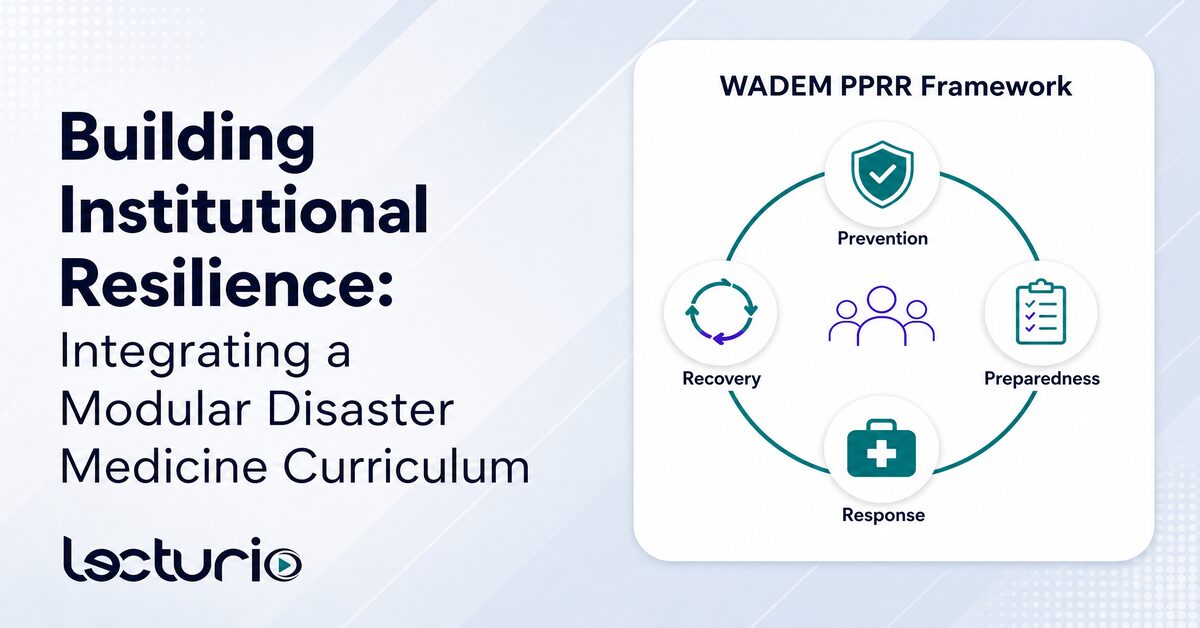
To ensure structural compliance and educational validity, institutional leaders can anchor all syllabus, tracking, and evaluation decisions within the WADEM position statement’s PPRR (Prevention, Preparedness, Response, and Recovery) model. Deploying a layered pedagogical mix is essential, as no single educational approach provides sufficient preparation for complex disaster environments. Medical and nursing programs can implement a structured, progressive continuum of training modalities:
- Didactic Frameworks: Utilizing digital video lectures and flipped classroom models to establish core foundational concepts of the PPRR framework.
- Case-Based Logic: Embedding targeted Qbank modules to systematically enhance clinical reasoning and triage decision-making.
- Simulation Matrix: Introducing low-stakes tabletop exercises at least once per year to assign operational roles, moving into high-fidelity simulations for mass casualty incidents, chemical exposures, and virtual patient pathways.
Standardizing learner performance assessment requires moving beyond simple course completion metrics toward objective, data-driven rubrics. Instructors should build standardized grading rubrics aligned precisely with WADEM competency descriptors to capture clear institutional and accreditation metrics.
However, structured debriefing must be treated as a core educational strategy rather than a mere extension of assessment. Utilizing validated frameworks, such as Debriefing with Good Judgment following every experiential session, serves as a vital pedagogical engine. It creates a dedicated space for active reflection, allowing learners to analyze team dynamics, deconstruct clinical errors, and develop the adaptive expertise and shared decision-making required to navigate flattened crisis hierarchies.
Worksheet Download: Is your curriculum aligned with global health security metrics? Download the Healthcare Educators Worksheet: Your Teaching and Assessment Checklist to instantly map your program’s training modalities against the WADEM PPRR framework.
Conclusion: Achieving Modular Curriculum Integration with Lecturio
Health professions education worldwide is bound by an acute curriculum squeeze, leaving deans and program directors with minimal opportunity to add extensive, semester-long courses. The solution resides in strategic integration over total syllabus overhaul, inserting high-yield, modular content directly into existing clinical and pre-clinical milestones. Rather than creating a standalone ‘Disaster Medicine’ block, institutions can map specific competencies to relevant existing courses. For instance, crisis communication and the ethics of scarce resource allocation fit naturally within first-year professionalism or medical ethics tracks. Meanwhile, advanced triage protocols can be embedded into emergency medicine clerkships, and public health emergency responses can be integrated into community medicine rotations. Exploring optimized resources built specifically for healthcare institutions enables programs to bridge these training gaps seamlessly.
The Lecturio platform directly addresses these administrative and pedagogical constraints:
- Modular DCC Curriculum Integration: Turnkey Disaster Casualty Care modules drop directly into existing pre-clinical and clinical tracks without disrupting core schedules. This allows for cross-curricular embedding, such as:
- Pre-clinical Blocks: Integrating disaster-response communication into first-year professionalism courses, or resource allocation ethics into medical humanities.
- Clinical Rotations: Inserting field and hospital triage modules into emergency medicine or surgery rotations, and epidemiology/surveillance modules into community health tracks.
- Scenario-Based Synthesis: Utilizing AI-supported interactive clinical reasoning and virtual patient applications via Healer to sharpen critical systems thinking under acute cognitive pressure. Try a free Healer case here.
- Data-Driven Accountability: Providing comprehensive institutional dashboards that measure, monitor, and support competency tracking and improvement efforts to streamline international accreditation reporting.
The table below demonstrates the institutional impact of transitioning from traditional, standalone curricular setups to an optimized, modular disaster medicine framework:
| Training Attribute | Traditional Curricular Model | Lecturio Transformed Model | Institutional Outcomes & ROI |
| Curricular Structure | Fragmented, optional extracurricular activities | Integrated, turnkey modular DCC content insertions | Protects faculty workload and saves core clinical curriculum hours |
| Pedagogical Modality | Isolated out-of-hospital triage or basic first-aid | Layered didactics, tabletop exercises, and high-fidelity simulations | Enhances clinical reasoning and diagnostic decision-making |
| Competency Tracking | Subjective completion logs or non-standardized metrics | Standardized rubrics mapped to WADEM 2025 descriptors with automated tracking | Generates actionable data for accreditation reviews and program audits |
Equip your graduates with the clinical systems reasoning required in today’s unpredictable landscape. Access a Free Preview of the AidUP Course and Download Your Program Checklist to discover how easily modular disaster medicine training can integrate into your university’s program. Ready to see the platform in action? Connect with our team today for a guided, 1-on-1 walkthrough tailored directly to your institution.
Frequently Asked Questions
How does a modular disaster medicine curriculum reduce faculty workload?
A modular framework reduces faculty workload by offering pre-mapped, turnkey digital lectures, Qbank questions, and structured simulation rubrics that drop directly into existing clinical rotations. This eliminates the need for instructors to develop new lesson plans, coordinate complex independent assessments, or rebuild core course syllabi from scratch.
How can institutions track disaster preparedness competencies for accreditation?
Institutions can track disaster preparedness competencies by employing standardized grading rubrics aligned directly with WADEM competency descriptors combined with data-driven institutional dashboards. These platforms automatically capture student progress, quiz metrics, and performance outcomes, providing clear, auditable evidence for regional and international accreditation boards.
What roles do simulation tools play in developing crisis leadership?
Simulation tools, including tabletop exercises, virtual patient applications, and high-fidelity mock mass casualty incidents or simulated pandemic outbreak responses, place learners inside high-stakes clinical scenarios where they must assume specific leadership roles. These structured models require students to practice rapid command, interprofessional care coordination, and critical resource allocation under strict temporal pressures.